What Bitcoin mining is and how it works
Mining is the process that validates transactions and creates new bitcoins. Understand how it works, why it consumes so much energy and what changes with each halving.
What miners actually do
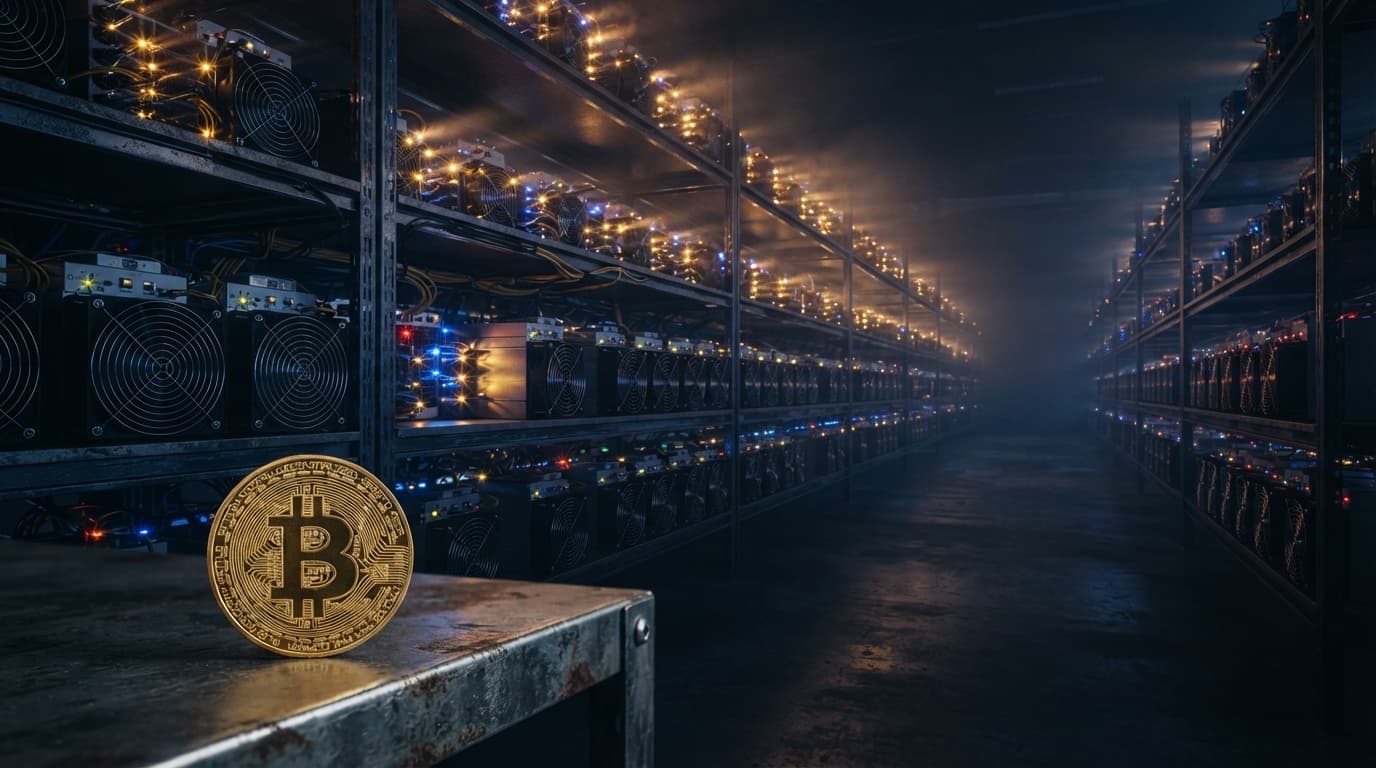
Mining has nothing to do with digging. It is the process by which computers validate transactions and group them into blocks, keeping Bitcoin's ledger running and up to date.
These computers compete to solve a calculation that can only be solved through trial and error. There is no shortcut or formula: it means testing trillions of combinations per second until finding one that works.
The first to succeed adds the next block and receives two things: newly created bitcoins and the fees paid by those who transacted in that block. This is how new coins enter circulation — nobody decides to issue them.
Why spend so much energy deliberately
High consumption is not a design flaw: it is the security mechanism. Because adding a block is expensive in energy and equipment, attacking the network would cost proportionately as much.
To rewrite transactions, an attacker would need more computing power than the entire rest of the network combined, sustained for long enough. The cost far exceeds any likely gain — and it is precisely this imbalance that protects the system.
In short: energy expenditure is the price of not having to trust any central authority. Those who consider the price too high have a legitimate argument; it is the main criticism of Bitcoin, and what motivated Ethereum to change its mechanism in 2022.
The halving
Every 210 thousand blocks, approximately four years, the reward per block is cut in half. The event is called the halving and has already occurred four times: 2012, 2016, 2020 and April 2024.
The reward went from 50 bitcoins per block in 2009 to 3.125 today. Around 2140, new coins will stop being created and miners will begin relying solely on transaction fees.
Each halving cuts the entry of new coins into the market in half, focusing attention on the price in the months around the event. For miners, the effect is more direct: those operating with thin margins and expensive energy tend to switch off their machines.
Difficulty adjusts automatically
There is an elegant detail in the design: the network does not produce blocks faster when more miners join. Every 2016 blocks, about two weeks, it measures how long they took and recalibrates the calculation's difficulty.
If many people joined and blocks were produced too quickly, the problem becomes harder. If miners switched off and blocks were delayed, it becomes easier. The target is always the same: one block every ten minutes on average.
This keeps issuance predictable over decades, regardless of the number of participants. And it is what allowed the network to keep operating without interruption when China banned mining in 2021 and more than half of its capacity disappeared within a few weeks — blocks were delayed, difficulty fell at the next adjustment and the pace returned to normal.
How the activity works today
Mining with a home computer stopped being viable more than a decade ago. The activity uses equipment manufactured exclusively for this purpose, ASICs, and operates in warehouses with industrial cooling infrastructure and negotiated energy contracts.
The key expense is energy. Professional operations locate where electricity is cheapest, and many seek renewable sources, surplus energy that would be wasted or gas that would be flared without use in oil fields. After the Chinese ban in 2021, the activity redistributed — the United States, Russia and Kazakhstan absorbed most of it.
Individual miners usually join groups, called pools, sharing the work and reward in proportion to each one's capacity. Alone, the chance of finding a block is so remote that the investment is not worthwhile.
The environmental criticism, without either extreme
It is Bitcoin's most disputed point, and the debate is often fought with numbers cherry-picked by both sides.
On the critical side: the network consumes electricity on a scale comparable to entire countries, to process a much smaller volume of transactions than conventional payment systems. Compared per transaction, its energy cost is orders of magnitude higher.
On the defense side: a significant share of the energy used comes from renewable sources or surplus that would have no other use, because miners seek the cheapest electricity — which tends to be precisely the electricity nobody else wants, at times and places with excess supply. There is also the argument that comparing per transaction ignores that the expenditure supports the security of the whole system, not each individual operation.
An honest assessment recognizes both things: consumption is high and deliberate, and the source of that energy varies greatly by region. Anyone treating the issue as a non-problem or an absolute catastrophe is oversimplifying.
Informational and educational content. This is not investment advice.
