What cryptocurrencies are and how they work
Cryptocurrencies are digital tokens that use cryptography to control how they are created and transferred. Bitcoin was the first; today there are thousands.
The definition
A cryptocurrency is an exclusively digital token. It uses cryptography — hence the name — to govern how units are created, how they are transferred and how secure this is. And here is what attracts most people: it does not depend on a central bank or government to exist or operate.
The first was Bitcoin, described in October 2008 in a nine-page document signed under the pseudonym Satoshi Nakamoto. Its title was direct: "a peer-to-peer electronic cash system". The network went live in January 2009. Today there are thousands of others, running on dozens of different blockchains.
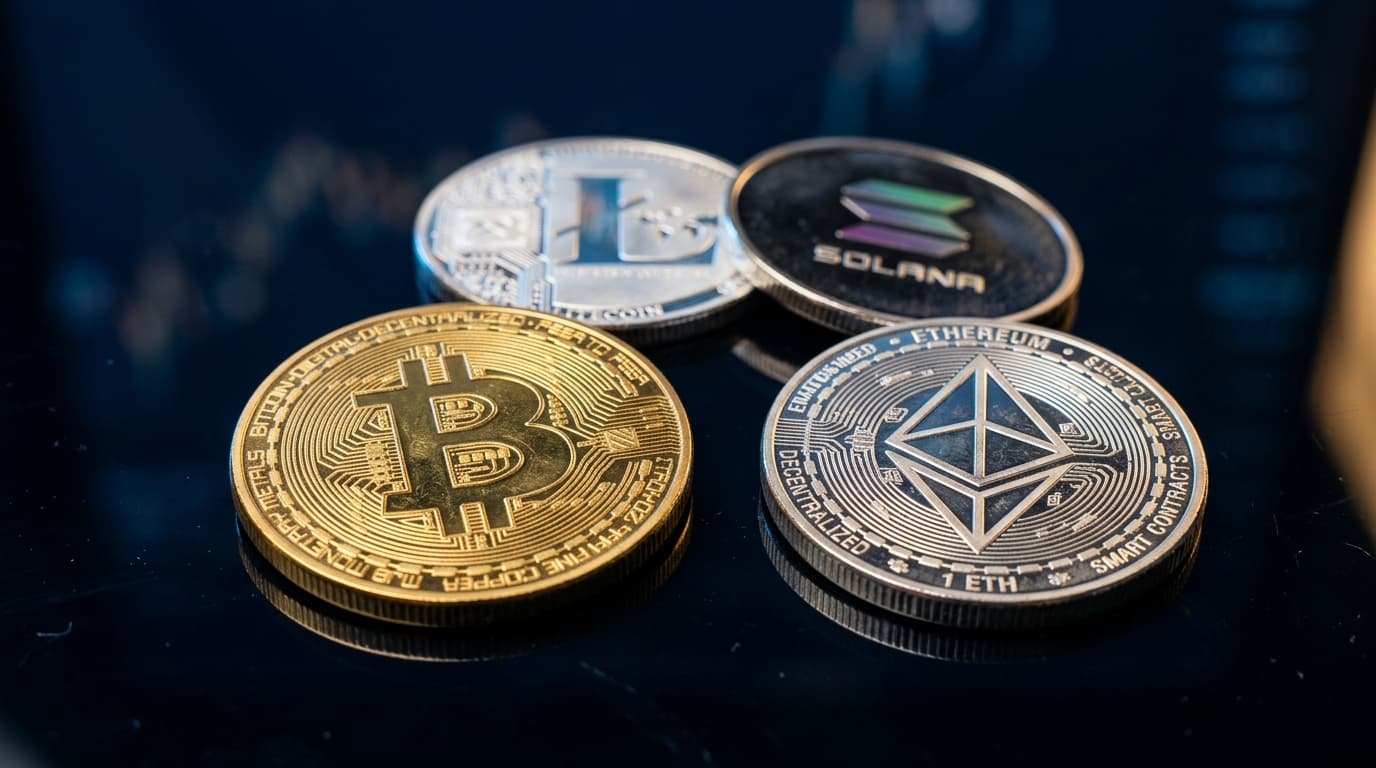
- Digital: They are native to the internet. You cannot touch them. Those illustrations of bitcoins as gold coins with a B are just illustrations — none of that exists physically.
- Decentralized: Transactions are stored in a public ledger maintained simultaneously on thousands of computers, called nodes. There is no official copy held by a company.
- Peer-to-peer: Transfers take place directly between the parties, without an intermediary approving the transaction. This is the most concrete difference from a bank transfer.
How new coins are created
Most cryptocurrencies — not all — generate new units through mining. In this process, individuals and companies use specialized equipment that competes to solve cryptographic calculations and validate groups of transactions, called blocks.
Whoever succeeds first receives the newly created coins. In Bitcoin, this reward is cut in half approximately every four years, in an event called the halving, designed precisely to slow issuance. It began at 50 bitcoins per block in 2009 and has already undergone four reductions: 2012, 2016, 2020 and 2024.
Not every network works this way. Ethereum abandoned mining in September 2022 and began validating transactions through staking — those wishing to validate lock up coins as collateral and lose the deposited amount if they attempt fraud.
What they are used for today
There is legitimate debate about whether cryptocurrencies behave like money or commodities. Part of the market prefers to call them digital assets, and in Brazil Law 14.478/2022 adopted the term "virtual assets".
In any case, they were never created just to replace the real or the dollar. Those that came after Bitcoin addressed very different problems:
- Litecoin (2011): Created by Charlie Lee from a fork of Bitcoin's code, with faster blocks. Its stated aim was to be the silver to Bitcoin's gold.
- Ethereum (2015): Designed to run applications and automated contracts, not just to transfer value. Its native coin, ether, pays for processing those applications.
- Filecoin (2020): It allows people to rent storage space on third-party computers, like a distributed Dropbox. It shows that a token can represent a service, not money.
- Stablecoins: They track the price of a traditional currency, almost always the dollar. They are used to move between applications without experiencing the market's typical volatility.
Why there are so many
Bitcoin solved the central problem of digital money: preventing the same unit from being spent twice without needing a bank to check. But it did not solve everything. It is slow for small payments, does not run programs and consumes a lot of energy.
Each limitation became the starting point for a new project. Hence the number. The trade-off is that most go nowhere — many projects are abandoned, and some are created only to raise money from people drawn in by the excitement.
What they offer that traditional money does not
It is worth understanding the advantages without exaggeration — each comes at a cost:
- They have no borders: Sending to another country is the same as sending to a neighbor: the same network, the same time. There are no banking hours or business days.
- They do not depend on government: In countries with high inflation or capital controls, they become a concrete alternative. In Argentina and Venezuela, the use of dollar stablecoins grew for this reason.
- They are pseudonymous: An address does not carry your name — but all its transactions are public and permanent. Blockchain analysis frequently identifies owners. It is not anonymity.
- They execute contracts: A program can automatically hold and release funds when agreed conditions occur, without depending on anyone to honor the agreement.
The trade-off appears at the other end. A transfer cannot be reversed: money sent to the wrong address or to a scammer does not come back. And the system's security does not protect you from yourself — a lost key means a lost balance, with no support service able to recover it.
In Brazil
Buying, selling and holding cryptocurrencies is legal. Law 14.478/2022 established the framework for virtual asset service providers, and the Central Bank was designated as the sector's regulator.
Transactions involving cryptoassets may create reporting and tax obligations, depending on the case. Consult the current guidance from Brazil's Receita Federal and an accountant to check the rules applicable to your situation.
Sharp fluctuations are a feature, not an exception. Bitcoin rose to around 20 thousand dollars at the end of 2017, fell more than 60% in early 2018 and took three years to return to the same level. Anyone who needs the money in the short term risks having to sell at the worst moment.
And the rule that needs no technical analysis: a promise of guaranteed returns is the most reliable sign of fraud. No serious investment offers a certain return.
Informational and educational content. This is not investment advice.
